Showing posts with label this world we live in. Show all posts

30 October 2011

feed the balance of the people.

I was teaching Voices of Protest this week, and like my students, I was startled by the familiarity of speeches delivered 75 years ago. 


‎"How many men ever went to a barbecue and would let one man take off the table what's intended for 9/10th of the people to eat? The only way to be able to feed the balance of the people is to make that man come back and bring back some of that grub that he ain't got no business with!" - Huey Long


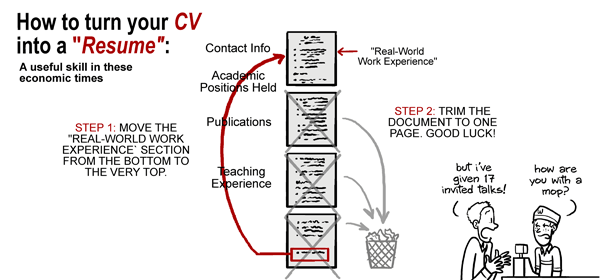
This infographic is worth meditating on as well. 

26 August 2011

never confuse substance with symbolism.

I don't agree with the notion of King as the singular representative of the civil rights movement any more than I agree with the notion of West as the singular (and self-appointed) representative of all black or poor people everwhere, but this I can get on board with. Memorials should not be equated with absolution, pretending public memory, or the delusion of a complete and successful civil rights movement:


"King’s response to our crisis can be put in one word: revolution. A revolution in our priorities, a re-evaluation of our values, a reinvigoration of our public life and a fundamental transformation of our way of thinking and living that promotes a transfer of power from oligarchs and plutocrats to everyday people and ordinary citizens.
In concrete terms, this means support for progressive politicians..., extensive community and media organizing; civil disobedience; and life and death confrontations with the powers that be. Like King, we need to put on our cemetery clothes and be coffin-ready for the next great democratic battle."

22 August 2011

inside-out.

I spent the last week at a national training institute for a prison education exchange program called Inside-Out. It is difficult to sum up my time with that group and what I learned, but there was a moment that was illustrative of where our hearts were after learning a great deal about how to facilitate courses in a prison setting.


Saturday we made our second trip to the prison. We went on Wednesday. It was an intense day-- there is nothing like waiting for two hours because the prison is on lockdown. Nothing like realizing that you are beyond the walls-- walls that our government built to keep these people in, to keep people like me out. Nothing like seeing the desperate hunger for knowledge and the many ways that knowledge liberates. Nothing like coming to know changed hearts that want change in the world. We met lifers and men who had three or six years left on their sentences. Men who give their 40 cents to 2 dollar an hour wages to scholarship programs for the children of other incarcerated men. Men who will be forever be defined by the worst thing they ever did. Men who came into the prison as children and will probably die there.


So when we had made our way along the winding country roads to the prison, our hearts were heavy. We had learned a lot in our training and we were coming to the prison to learn yet more from the men who were training us inside. When our car turned the corner, the first thing I noticed was the fog. The prison silhouette loomed large. And then I looked a little closer- and I saw people dancing.


In one of the cars, some women had fallen asleep on the drive out. The other women in the car turned up the music really loud to wake them up. The doors flew open and they began to dance. With each car in the caravan rolling in, people spilled out and joined this parking lot soiree. I did too.


our cheesy, unlikely anthem


The rules that govern prison parking lots are restrictive- you are told where to park, no pictures or videos, you come in as few cars as possible. You can't have maps laying out when you go in. As we danced, I could see a guard stepping out of the tower to watch, backlit by sun and fog. A truck with a correctional officer in it circled the parking lot. It dawned on me that this was very, very subversive. It was the most radical thing I had ever been a part of.


But in spite of the surveillance, and maybe because of it, we danced for the whole song. We danced because we know we are free. We danced because we needed strength to go into that milieu to do our best work. We danced because the kind of people that want to teach in prison are the kind of people who dance in parking lots. We danced because we believe we can make walls come down.

We were grateful that we didn't get in trouble for our dance party. Our program is fragile and we know that. The guards were genuinely amused and we haven't heard of any blowback.


We went into the prison that day knowing that we had just experienced something that had defined us as a group, something that we would return to as we spread out to fill our different missions across the United States and Canada. What we do is sobering and hard work, and I came away with a greater appreciation that my heart and my spirit will always need to be in the right place for me to do the work effectively. We had a beautiful day in the prison as we communed with intelligent people who believe in the power of our program. It was hard to say goodbye because it is hard knowing that human beings are kept in cells. It is hard knowing, really knowing, that you are free and others are not.


We did not dance when we left.

28 March 2011

the imprisonment of a race.

Last Friday I trekked out to Princeton for the Center for African American Studies' conference "The Imprisonment of a Race." The conference was the brainchild of an undergraduate student in molecular biology. Originally from Inglewood, California, he was troubled by the fact that more young black men go to prison than to college. He wanted to raise awareness about the issue, so he went to CAAS. He expected maybe a professor and some kids in chairs in a classroom. What he got, however, was to help plan a conference that brought together some of the finest scholars writing about race and incarceration today. It was the kind of event that made me feel grateful to live where I do; it's a gift to have access to the resources of the Ivies.


It was a major event for me. It wasn't just that it was a networking event, or that there was some really interesting research I hadn't heard about yet-- though both of those things were big draws. It was the power of sitting in a room with several hundred people having a consciousness-raising experience.  The research was provocative-- I learned about, for instance, how children are policed and conditioned to punative punisment in schools and neighborhoods, how census counting of inmates in prisons rather than their neighborhoods of origin means less money for already poor communities (reproducing the circumstances of poverty that spawn most crime), and how it costs the Commonwealth of Pennsylvania twice as much to incarcerate a prisoner than to pay the tuition of a student at Penn State. I heard the voice of Mumia Abu-Jamal, a political prisoner on death row-- that he joined our conference by phone, with the periodic interuptions of a recording us telling us that the phone could be being recorded, added a potent sense of urgency to the day's proceedings. I heard research I am familiar with-- how prison riots and internal resistance show that "the carceral state is, in fact, fragile," and how during the Progressive era whites were treated for poverty, blacks were neglected because of their assumed criminal pathology, and these events laid the foundations for mass incarceration. I heard all of the familiar statistics about incarceration in America- how of 2 million people incarcerated today, half are African-American, how 5 million people in this country are disenfranchised because they committed felonies. Everyone agrees that there are evil people who should be locked up, but that locking up for non-violent crimes and racist policing have occurred on such a grand scale of inequality that it they have become less effective, and indeed, manifestations of the fundamentally undemocratic nature of American governance and a need for a continued human rights struggle.


I heard over and over again:
Prisons destroy the spirit.
Prisons do not correct behaviors.
Prisons undermine family life. 
Prisons produce fractured citizenship that encourages recidivism. 
Prisons are the only policy Democrats and Republicans seem to be able to agree on. 
Prisons-- in all their dehumanizing, demonizing, unjust incarnations-- are evidence of our society in it most realized form (Foucault). 


The word "suffering" must have been said a hundred times.


There were moments when I felt close to tears. I feel that way when I read about prisons, too-- a sense of despair that these institutions are so entrenched that they seem beyond reform. 


It was a blessing, then, to round out the day with a conversation between public intellectual Cornel West and Michelle Alexander, author of The New Jim Crow.  West offered me hope-- he reminded me that I have the power, in our my own life, to infuse my work with a spiritual motivation. He spoke plainly, truthfully: Justice is love practiced in public. Michelle Alexander reminded me that for everything I'd heard, I have a responsibility to bring awareness to the issues surrounding incarceration and inequality.  I can change the words I use- I don't have to use the term "felon" to describe the formerly-incarcerated because I can use my language to show others than I believe in forgiving those who have done their time. I can work for reform and rule shifting but I can also work for a revolutionary transformation of culture.  There is hope in that. 


My favorite quote came from Khalilah Brown-Dean, and I think I might have to embroider it to hang over my desk as I write my dissertation:
"My research is my advocacy."

13 March 2010

escalating equipment demands.


This afternoon I find myself staring out the window, wondering if I'm really willing to bike it to my evening social commitment this evening.  I have great rain gear, but it is raining so hard.  Like tons-of-standing-water-on-the-road-hard, drivers-hitting-huge-puddles-that-would-leave-me-soaked-to-the-bone hard, I-can't-really-see-myself-journeying-into-unfamiliar-territory hard.  It's not that I'm unwilling to ride in the rain, I tell myself.  It's just that I need a poncho.


A poncho? Really?  What have I become?


It hit me that my experience as a car-free adventurer has been marked by the steady acquisition of increasingly sophisticated equipment.  Arriving in Philadelphia, I owned the Old Dutch Treat, a basket, and a seldom used Blinkee light.  Then I bought the Dahon so I didn't break myself doing the stairs with the ODT every day.  Then I realized doing so many miles probably mandated a helmet, so I bought the Nutcase.  Then I got rain gear because I realized it was going to be a long wet winter.  Then I found I needed a better headlight for all the night riding I wanted to do on the Dahon. After the bike-deprived onslaughts of blizzardy, I found myself plotting how I might build up a snow bike for next year (I don't know that I ever blogged that fantasy, but I sure felt it) (ha... back in Utah I thought I was so cool for riding in the snow).  And the good lord knows that I would always like a road bike.  


I often find myself thinking that the only thing keeping people of their bikes is having a bike, or the only thing that it takes for me to ride successfully in the rain is a little bit of waterproof mascara.  It irks me a little to realize the reality of my lifestyle-- and the roadblocks that it might present to others wanting to make the change-- is that it is marked by consumerism.  I'm ok with that for myself-- I have no qualms about spending some of the proceeds from my car's sale on bike paraphernalia or, to cast it in even holier terms-- supporting bike related companies that I think are doing good things for the world.  I have no problem sleeping at night because I have a good raincoat or a folding bike.  But when I think about making cycling accessible and appealing to everyone, how to mediate the goods issue is quite the quandary.  I'm glad there are programs in Philly like Neighborhood Bike Works that help to improve bicycle access, but I'm curious as to what other solutions to that issue might look like.  Sure, you can bicycle commute on a bike-shaped-object, but it probably sucks not to have fenders or to be invisible to motorists without lights.


Now if you'll excuse me, I'm going to go back to meditating on how I might acquire a poncho without getting soaked.

13 November 2009

confronting the hard parts.

I like what I do. It's a privilege to tell the stories of others. I've enjoyed meeting the people I study. I love going to conferences, I love going to class, I love the feeling the feeling of opening up a box and not knowing what I'm going to find. The challenges of interpreting the past engage me deeply. I have made a lot of sacrifices because being a historian is so satisfying and rewarding that I want to do it for my whole life, and I want desperately to learn how to do it well.


I love to study New Right conservatives. I admire their passion and temerity. Their rhetoric and writing captivates me. Making sense of a time in which my parents came of age and the moment I was born into has great appeal for me. I have come along way since I started studying these people, and I really, genuinely appreciate what they have to say and how they challenge my worldview.


I say all this because today I had to confront the aspect of my topic I hate the most. It's impossible to write about the New Right without talking about abortion.  For many social conservatives, it's the reason they mobilized, the one thing in the world that they would give anything to change.


I hate reading about it. I hate talking about it. I would do anything to avoid it all together.


The descriptions in pro-life literature, while well-intentioned, are often grizzly and grotesque. They depict excessive and unusual procedures, and overemphasize poorly handled situations.  I concede that it is purposeful and deliberate language. But I think that by and large pro-life accounts are as decadent as the behaviors they are intended to critique.


It has little to do with the fact that I'm pro-choice. I believe that women should have  access to safe medical procedures should they elect to do so. I stand with Linda Gordon in acknowledging that women have made this choice throughout history regardless of its legality, and with Barack Obama who feels that unwanted pregnancies should be prevented through affordable birth control and comprehensive sex education. Like Ruth Bader Ginsburg, I believe that it is not a question of either / or. But my politics seldom enter the picture. I am guided by professional ethics and exercise a level of restraint that others have called judicious and even admirable. What I write is not about me. I am not trying to change anybody's mind, nor am I open to my mind being changed.


I just don't like reading about blood and tissue. Needles, suction, disposal, no thank you. I think it's a terrible way to spend the day. It makes me miserable. I don't find it enjoyable to try to understand what's going on in the text; I find it so abhorrent that I struggle to get motivated when I have to address the issue. It's impossible to focus on, requiring breaks, endless coffee, snacks, checking of blogs, email, twitter, and anything that might offer relief from the task.  If someone called and said, "Hey, would you like to come clean my toilet?" I would probably opt for that.  My work ends with descent into exhaustion and then unsatisfying naps. I wind up feeling drained and find it near impossible to shake off the dirty feeling I get from reading this rubbish. To use a turn of phrase from my Mormon days, it offends my spirit.


I love what I do. I love what I study. I wouldn't change my path even if I could. 
But what do we do with the parts of our jobs- our vocations- that we hate? 

13 September 2009

on safety.

All this reading of cultural history- a big thing in my program here- lately has really attuned me (more than usual) to language and the meanings of well, everything.* After reading about the tragic disappearance and murder of PhD Student Annie Le, which hit pretty close to home, I couldn't help but consider how often the issue of safety has been coming up lately. What is safety? How so we define what is "safe" and "unsafe"? What does it take to feel safe? When is safety an illusion, and really, why do we care about safety? What are we so afraid of? What do we do when the drive for safety interferes with our ability to live well? How do we judge that?

There's obviously no real answer to this, and even discussing it leaves me wide open to criticism and a sense of discomfort arises (is it safe to talk about safety? on my own blog??). I'd thought about putting it on a spectrum and attacking it that way, but the more I chew on this the more I realize that safety is too complex for that (oh cultural history perspective, you are ruining me!). So here's the three instances that have caused me to consider safety lately. I'll present the evidence, maybe make some conclusions, and then you can tell me where you stand if you like because I am really curious about what we conceive safety to be.

1. Bike Helmets
I don't own a bike helmet. It didn't make it into my car when I left Utah because I had worn it all of 5 times while I lived there; it didn't fit right, it looked dumb, and in my opinion, one doesn't need a helmet when riding on sidewalks on campus (which at Utah was an accepted practice, not a lawbreaking activity like it is here in Philly) unless it's icey. The reasoning I usually gave for not wearing a helmet were:
a. I ride a very heavy steel bike rather slowly.
b. I don't like biking to appear unsafe (!) because like others, I generally don't think it is. I follow the rules of the sidewalk / road, after all.
c. Unattractive, sweaty head, messed up hair, etc. etc.

However, now that I am:
a. on the road a lot more
b. riding a smaller, lighter bike, faster

I've been questioning whether this change of circumstances makes me less safe and mandates a helmet. I don't feel less safe. I choose what bike to ride based on where I'm riding at what time of the day to ensure that I am slow, sturdy, and visible when I'm in the dark or in high traffic areas. On one side is the friend how says, "You never know when you could get hit," and on the other side is the friend who, having been hit several times while not wearing a helmet says, "Whatever."

See how fraught safety is? You could be doing everything you can to prevent injury (whether or not that includes wearing a helmet) and still get injured.

2. Walking around.
I live in a pretty social neighborhood. People are always chatting me up, on the bike, walking, at the bus stop, whatever- this place is to me, unavoidably interactive. I love it. On the other hand, women's safety has been compromised in this city in recent history (see here and here). I work hard to be aware of my surroundings and don't talk to everyone who talks to me, and steer clear of scary places or opt to ride my bike if I have to travel through. A recent article in the NYT threw down all the arguments for and against letting kids walk to school, and I think catches this argument pretty well- statistics, social pressure, desire for independence- there's a lot at stake and a lot that factors into how we perceive what is safe.

Ok. This is starting to feel tedious, I think I am belaboring the point and getting a little tired and incoherent.

3. Annie Le.
Security records show that this girl went into a building- a "secure" campus building, no less- and she never came out. What more is there to say about that? Given the nature of the small communities that work in places like that... yah, there is really nothing that can be said.

It seems to be that feeling unsafe is a recognition of when our agency can be unexpectedly trumped by that of others or circumstances to in large or small ways change our destinies (or outcomes, if we are feeling less dramatic). It seems an issue of control- how much control do we need to have to feel like we can function? At what point do we have to let go and let faith kick in so we can live? I feel like so much of the time whether I feel safe or not is contingent on the "vibe"- if I get a bad vibe, feel some dark energy, or whatever, I am out of there, I am calling the cops, I am doing whatever it takes to make the circumstances feel right. But after you've done all you can do, there's still nothing you can do, ya know? How do you reconcile that? In in the end, is safety just a construct or is it really important?
14 July 2009

reflections on "the way 'we' live now."

David Brooks' column really got me today. I have been following the Sotomayor confirmation pretty closely because I've found it all together horrifying. The questions mustered under the euphemistic concern over her "identity"- her race, ethnic heritage, and gender (pick your construct!) have angered me deeply. Is this the America I live in? Why is her racial identity an issue when John Roberts' wasn't?

So I've been mad because it's so out of control and as a homeless person I can't open the safety valve with a quick email to my elected representative (Utahns, do you know what your senior senator has been up to today?). Fortunately the Brooks column helped me to see a different side of things. He looks at Sotomayor's biography and says, yah, it's an awesome American story about civil rights coming a long way, but also, "It’s the upward mobility story — about a person who worked hard and contributes profoundly to society, but who also sacrificed things along the way."

Brooks then goes on to catalog Sotomayor's relationships throughout her life- an extended family as a child, mentors, friends, and a spouse as an adult. This was the part of the piece that really hit me. Excuse the lengthy quote:

"This isn’t the old story of a career woman trying to balance work and family. This is the story of pressures that affect men as well as women ... It’s the story of people in a meritocracy that gets more purified and competitive by the year, with the time demands growing more and more insistent.

These profiles give an authentic glimpse of a style of life that hasn’t yet been captured by a novel or a movie — the subtle blend of high-achiever successes, trade-offs and deep commitments to others. In the profiles, you see the intoxicating lure of work, which provides an organizing purpose and identity. You see the web of mentor-mentee relationships — the courtship between the young and the middle-aged, and then the tensions as the mentees break off on their own. You see the strains of a multicultural establishment, in which people try to preserve their ethnic heritage as they ascend into the ranks of the elite. "

I wish I didn't feel this so deeply. I'm not pretentious enough to say I'm apart of the "elite" or to seriously self-identify as "a high achiever," nor am I naive enough to think that these strains are limited to those of a particular educational level or class attainment. But, I can say wholeheartedly that I have felt what Brooks describes, and to see it on 'paper' freaked me out, but it also gave me a lot of comfort. Particularly when I consider the crazy semester I just finished, where the work I loved started to feel like my undoing and I struggled to negotiate my role as a "mentee," it was nice for someone in the world to point out that yes, this is common.

Brooks concludes powerfully that in Sotomayor's story, "You see the way people not only choose a profession, it chooses them. It changes them in a way they probably didn’t anticipate at first.... You don’t succeed at that level without developing a single-minded focus, and struggling against its consequences."

Every time I read that quote, the tears come right into my eyes. I don't think I ever could have comprehended how consuming graduate school would be- the development of my single-mindedness was for me a somewhat painful process. It happened as soon as I started my program, as I confronted what it meant to miss my nieces' birthday and how little time and energy I had to manage the significant issues I had with my faith. It wasn't that those things quit mattering or that I became immune to the sting I felt from them, but like pioneers chucking stuff out of a wagon to lighten the load, I learned how to tune stuff out that wasn't right in front of me so I could handle the tasks at hand. I think that's been the craziest part-- somewhere between those heartrending first couple of months and the moment towards the end when moving east didn't seem like such a big deal because it felt like the only deal. It's still something that's constantly being reconciled, but I would say by and large, at some point the consequences stopped feeling sad and ultimately I've gotten to the point where doing what needs to be done so I can do what I want to do makes me really happy.

Nobody told me that that would happen.

(Brooks doesn't talk about the happiness element much, but that's what this article made me think about. Being successful isn't entirely about surrendering relationships as he runs the risk of implying, but man, you do learn how to become happy spending time with yourself).

14 June 2009

vacation and mildly depressing politics sandwich.


Yes, it's true, borne out by my Twitter feed and many annoying facebook updates to tease and taunt- I'm in the UK and loving it. I decided to share this photo because it features prominent quadriceps gifted to me by the ODT, so you know, I can be a schmuck and brag about how fit biking's made me. With this picture I can also brag about how good the 9% apple cider is, but you know, I think that's pretty obvious.

Anywho, if you get the chance, check out Frank Rich's commentary on the recent spate of right-wing violence and conspiracy theories. Obviously, conspiracies are nothing new, but I
think Rich is correct that the lack of conservative / Republican leadership on the issue isn't helping and will cause further problems. Interesting stuff to chew on.

Here also is a fascinating summation of the Iranian elections. I too believe that the election was stolen and think it's a total bummer because well, the implications suck.

What, you're depressed now? Yah, well here's some tips on what to take to people who invite you over (I liked the idea of bringing a giant jar of Nutella) and a funny food oriented photo from the Tesco grocery store offering a good pairing for Father's Day. Best to eat our feelings
when it comes to domestic and international politics.


p.s. I laughed, I cried, I peed a little: "45 Ridiculous Pictures of Boy Bands." I miss the 90s!

06 June 2009

tidbits.

-A worthy historical op-ed from The Paper on "Abortion Wars, the first time around."  

-Mikael at Cycle Chic responded to the annoying glut of specially designed casual cycle wear. Word.

-I am obsessed with 107.7 The End's 90s weekend (live streaming here).  I didn't know it was going on until I was getting into the car with Big Sister and my favorite band of 1997 came on- Super Deluxe with their beautiful song "Years Ago."  Sadly videos of theirs are scarce on the interwebs because they were a local phenomenon- but hey, something is better than nothing! Nothing quite like the music of one's youth.


20 April 2009

vile and hateful.

This reminded me of this:


But really? Who invites a holocaust denier and mega-hater to speak at anti-racism conference? Do you invite a butcher to speak to a group of vegetarians?!
(Brace yourself for an insightful insight...1...2...3...)


That's dumb.*


*Michelle, that was for you. :P

13 April 2009

days like this drive me to online shopping.

Wild day in the world / on the internet today:

Obama is waging war on pirates

And trying to nationalize the student loan system.*

People are trying to forgive their spouses**

and others are fainting on Glenn Beck like it's a tent rivival.

Spain is putting the smackdown on torture since our courts won't

because they are too busy not being good.***

Ok, so maybe it was mostly a good day for reading The Paper. But still, kind of a wild mess huh? Watch this to wind down (free for a limited time!).

*the discomfort I feel over stuff like this-- even though it's for the good of the students-- ME-- is really making me wonder if I'm a fiscal conservative, or maybe if having GWB for president for my entire adult life screwed me up to the point that I can never be on the same side as the Prez.

**I liked this article because I felt like yelling at the whole planet this afternoon. Very tense afternoon. I pretended that I, like the main character, got to throw my fit.

***I could talk about the Supreme Court all day. Fascinating stuff.

10 April 2009

it's just not the same without the title.


Basically a sign that today has been too much...

What? That's not news? I'll show you news...

02 April 2009

picturing the recession.

The NYT has a new section called "Picturing the Recession." It's basically a community archive that people can upload photos and stories to. A lot of the stories are heartbreaking-- shuttered shops and foreclosed homes-- but I thought there were some positive messages that made me think of some of my special readers. You can click on the images to see the text better.

For Big Brother:


For Michaele:

click on the link and ask yourself if you can really handle this kind of shit before 10am.


The Barack Obama Action figure, with interchangeable heads and hands.

Really.

26 February 2009

it's not that it's too early for this, it's just that it is.

This is one of those mornings when I wish one could receive coffee intravenously. It would make it so much easier if you could see stuff like this in the paper:
without feeling like you're still asleep and just having a weird dream.

I wasn't going to link to this story because pet stories (what did you think it was about?!) usually reinforce "cat lady to the max" stereotypes... but there is too much crazy going on to resist. Monkeys that drop from the rafters and punch through peoples' scrotums? YES.*

*Sad for the animals... fortunately the story is very "You should not do this" in tone.